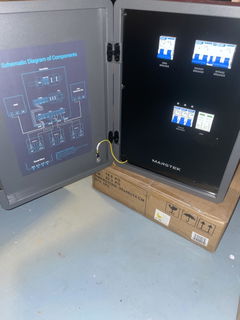
Collection: SolisStorage EverCore Commercial ESS for European Industry

SolisStorage EverCore Commercial ESS is designed for businesses that want full control over energy costs, grid capacity and operational continuity. From production facilities to logistics centres and utility buildings: EverCore transforms energy from an unpredictable cost factor into a strategic business asset. Rebor supplies five EverCore configurations: two variants at 100 kWh / 50 kW, two variants at 120 kWh / 60 kW and one model at 261 kWh / 125 kW, each available as a standard NV version or as an extended Pro-C5 version with an industrial safety package.

Definition: EverCore is an integrated Commercial & Industrial (C&I) energy storage system with hybrid architecture (DC/AC separation), four-in-one power electronics (PCS + MPPT + STS + EMS), LFP battery technology (314Ah EVE cells) and industrial air cooling, available from 100.5 kWh to 261.2 kWh per unit, scalable to 1.25 MW / 15.66 MWh in parallel systems.

Product overview: all 5 EverCore models in the Rebor range

The Rebor range includes five EverCore configurations across three power levels. Each power level is available as an NV version (standard industrial fire protection) and as a Pro-C5 version (extended safety package with gas detection, explosion relief panel, explosion-proof ventilation and acoustic/visual alarm). The 261 kWh version is exclusively available as Pro-C5.

Model Capacity gross / net Power Nominal voltage Configuration Dimensions (W × D × H) Weight cabinet + inverter Safety level Standards
EverCore-100kWh-50kW-NV 100.5 kWh / 90.5 kWh 50 kW AC (3-phase) 320 Vdc 5× 20.1 kWh LFP modules 1240 × 1540 × 2000 mm 1800 kg + 73 kg Standard NV IEC 62619, UN38.3, CE
EverCore-100kWh-Pro-C5-50kW 100.5 kWh / 90.5 kWh 50 kW AC (3-phase) 320 Vdc 5× 20.1 kWh LFP modules 1240 × 1540 × 2000 mm 1800 kg + 73 kg Pro-C5 — gas detection, explosion relief panel, explosion-proof ventilation, alarm IEC 62619, UN38.3, CE
EverCore-120kWh-60kW-NV 120.6 kWh / 108.5 kWh 60 kW AC (3-phase) 384 Vdc 1P120S (6× battery pack) 1240 × 1540 × 2000 mm 1940 kg + 73 kg Standard NV IEC 62619, IEC 63056, IEC 62477, UN38.3
EverCore-120kWh-Pro-C5-60kW 120.6 kWh / 108.5 kWh 60 kW AC (3-phase) 384 Vdc 6× 20.1 kWh LFP modules 1240 × 1540 × 2000 mm 1940 kg + 73 kg Pro-C5 — gas detection, explosion relief panel, explosion-proof ventilation, alarm IEC 62619, UN38.3, CE
EverCore-261kWh-Pro-C5-125kW 261.2 kWh / 235.1 kWh 125 kW (charge/discharge: 130.5 kW) 832 Vdc 13× battery modules (314Ah EVE LFP) 1750 × 1450 × 2250 mm 2500 kg + 170 kg Pro-C5 — gas detection, explosion relief panel, explosion-proof ventilation, alarm IEC 62619, UN38.3
NV vs. Pro-C5: The NV version includes standard industrial fire protection (aerosol, explosion relief valve, DN65 fire suppression connection, thermal detection). The Pro-C5 version adds: combustible gas detector (10-year calibration-free), explosion relief panel, explosion-proof exhaust fan and acoustic/visual alarm system.

Hybrid architecture & four-in-one power electronics

DC/AC separation: Physical and thermal separation between battery cabinet and inverter increases safety, simplifies installation and eliminates heat transfer between inverter and battery cells.

Four-in-one integration: PCS + MPPT + STS + EMS in one central controller (one CPU), fewer components, higher system efficiency, lower maintenance costs.

<10ms STS switching: The integrated Static Transfer Switch automatically switches to island mode within <10ms on grid failure — critical loads remain operational without restart.

Open software architecture: Compatible with 100+ external EMS and VPP platforms. Monitoring via SolisCloud (LAN, standard included with Pro-C5).

Thermal management: Industrial air conditioning (cabinet) combined with pack air cooling and intelligent inverter ventilation. Operating range: −25°C to +55°C | Altitude up to 4,000 m (derating above 2,000 m).

Battery cells: 314Ah EVE LFP cells with up to 8,000 cycles at 100% DoD.

Industrial safety & 15-layer protection system

All EverCore models are equipped with a 15-layer system protection from cell to complete installation. The exact composition differs per version:

Standard NV version (100 kWh and 120 kWh)

  • Industrial air conditioning
  • Aerosol fire suppression
  • Explosion relief valve
  • DN65 fire suppression connection
  • Thermal detection (smoke and temperature sensors)
  • IP55 cabinet / IP66 inverter
  • C4/C5 corrosion class (battery)

Pro-C5 version (100 kWh, 120 kWh and 261 kWh) — in addition to NV

  • Combustible gas detector (10-year calibration-free)
  • Explosion relief panel
  • Explosion-proof exhaust fan
  • Acoustic and visual alarm system
  • C5 corrosion protection (suitable for coastal and heavy industrial environments)
⚠️ Installation by certified high-voltage professionals only. Minimum clearance in front of the 261 kWh unit: 2,000 mm. Refer to the official installation manual for ventilation requirements, foundation specifications and minimum clearance distances. Compliance with local fire safety standards (NEN/AREI/VDE) is mandatory.
1. Why is commercial energy storage essential in the EU C&I market?

Rising electricity prices, grid congestion and capacity constraints make energy storage strategically necessary. A Commercial ESS reduces peak loads, stabilises energy costs, increases self-consumption from PV installations and ensures operational continuity during grid outages. SolisStorage EverCore offers five configurations from 100.5 kWh to 261.2 kWh, scalable to 1.25 MW / 15.66 MWh.

2. What technically distinguishes SolisStorage EverCore from conventional C&I systems?

EverCore integrates PCS, MPPT, STS and EMS in one central four-in-one architecture with physical DC/AC separation. Thanks to <10ms grid-to-island switching, 314Ah EVE LFP cells (up to 8,000 cycles at 100% DoD), industrial air cooling and a 15-layer safety system, maximum reliability is achieved with lower installation and maintenance costs.

3. Is EverCore scalable for industrial projects?

Yes. EverCore supports parallel operation up to 1.25 MW / 15.66 MWh. For configurations of more than 6 units, a Solis distribution cabinet is recommended for optimal grid balance and system integrity. Ideal for factories, logistics centres, campuses and energy-intensive business environments.

4. What is the difference between the NV version and the Pro-C5 version?

Both versions share the same capacity, power, battery architecture and <10ms STS switching. The difference lies exclusively in the safety package. The NV version includes standard industrial fire protection: aerosol, explosion relief valve, DN65 fire suppression connection and thermal detection. The Pro-C5 version adds: combustible gas detector (10-year calibration-free), explosion relief panel, explosion-proof exhaust fan, acoustic/visual alarm system and C5 corrosion protection for heavier industrial environments. The 261 kWh variant is exclusively available as Pro-C5.

5. Which EverCore model suits my situation?

Choose based on your peak consumption, desired storage capacity and environmental requirements. As a guideline: the 100 kWh / 50 kW models are suitable for medium-sized commercial installations; the 120 kWh / 60 kW models offer more storage capacity in the same cabinet format; the 261 kWh / 125 kW is intended for large industrial installations with high peak power demands. Choose the Pro-C5 version for installations in heavy industrial environments, coastal areas (C5 corrosion) or where local fire safety standards require an extended detection and suppression system. Contact us via the Rebor contact page for tailored project advice.

6. How does monitoring via SolisCloud work?

All EverCore models are compatible with the SolisCloud monitoring platform. The Pro-C5 versions include a LAN monitoring module as standard. Via SolisCloud you monitor real-time energy flows, battery status, peak load and system alarms. The open software platform is compatible with 100+ external EMS and VPP platforms for integration into broader energy management systems.

7. What are the installation requirements for EverCore systems?

Installation must be carried out exclusively by certified high-voltage professionals. The 100 kWh cabinets weigh 1,800 kg (excl. inverter 73 kg); the 120 kWh cabinets weigh 1,940 kg (excl. inverter 73 kg); the 261 kWh unit weighs 2,500 kg (excl. inverter 170 kg). For the 261 kWh unit, a minimum clearance of 2,000 mm at the front is required. Refer to the official installation manual for ventilation requirements, foundation specifications and minimum clearance distances per model. Compliance with local fire safety standards (NEN/AREI/VDE) is mandatory.