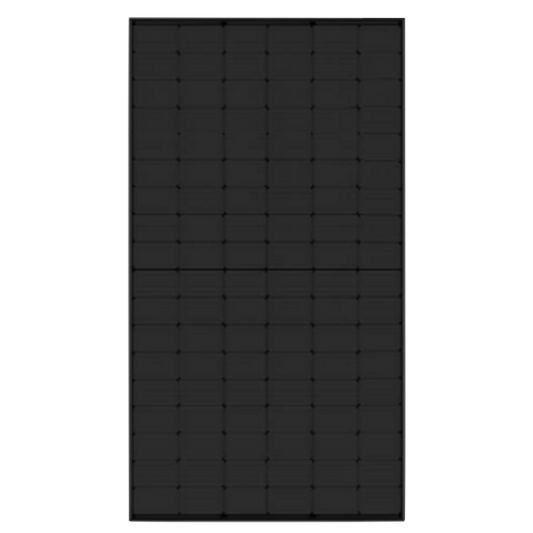
Collection: JA Solar Solar modules: PERC & Half-Cut

Rebor B.V. is EU wholesale distributor of JA Solar (JA Solar Technology Co., Ltd.) — one of the world's largest solar panel manufacturers and consistently ranked as a Tier-1 manufacturer. Our current range includes a selection of N-Type n-Bycium+ MBB half-cell panels with glass-glass construction, available in Full Black, Black Frame and bifacial versions — for both residential and commercial installations. All models in our range carry a Traceable supply chain certification. View the current models below for the exact Wp class and datasheet per model.

N-Type n-Bycium+ technology: what it is and what it means in practice

N-Type n-Bycium+ is JA Solar's proprietary N-Type cell architecture, combined with MBB (Multi Busbar) and half-cell technology. N-Type cells are inherently less susceptible to LID (Light Induced Degradation) than P-Type cells — first-year degradation is therefore significantly lower than with conventional P-Type PERC panels. The MBB structure distributes current across more busbars, reducing internal resistance and susceptibility to micro-cracks.

The half-cell layout halves each cell, halving the current per cell and reducing resistive losses. In addition, the parallel connection of the two halves of the panel means that partial shading on the lower half affects the upper half less than in a conventional full-cell panel. In practice: better performance under partial shading, lower heat generation and more stable yield in diffuse light.

All current JA Solar models in our range have a glass-glass construction (dual glass) — both monofacial and bifacial — offering superior mechanical protection, PID resistance and a longer service life compared to glass-backsheet constructions.

N-Type ≠ PERC: The current JA Solar models in our range are N-Type n-Bycium+ — not PERC. PERC is a P-Type technology with higher first-year degradation (LID) and a less favourable temperature coefficient. N-Type and PERC are fundamentally different cell chemistries and are not interchangeable as terms.

Construction and version variants: monofacial, bifacial and Traceable

All current JA Solar models in our range share the same N-Type n-Bycium+ MBB half-cell architecture and glass-glass construction. The difference lies in the version (monofacial vs. bifacial), aesthetics (Full Black vs. Black Frame vs. silver frame) and format. The comparison below is at construction and version level.

Feature Monofacial glass-glass
(Full Black / Black Frame)
Bifacial glass-glass
(Full Black / silver frame)
Cell technology N-Type n-Bycium+ MBB half-cell N-Type n-Bycium+ MBB half-cell
Light capture Front side Front and rear side — additional yield on suitable surface
Construction Glass-glass (dual glass) Glass-glass (dual glass)
Aesthetics Full Black or Black Frame — suitable for residential roofs Full Black or silver frame — depending on model
Typical application Residential roof, aesthetics as priority, monofacial sufficient Carport, flat roof, ground-mounted system, light-coloured surface
Traceable supply chain ✓ — all current models ✓ — all current models
Max. system voltage 1,500V DC 1,500V DC
Warranty structure 25-year product + 30-year linear performance 25-year product + 30-year linear performance

Which JA Solar panel suits your project?

Situation Recommended version Key advantage
Residential roof, fully black appearance required Monofacial glass-glass Full Black Fully black appearance, N-Type n-Bycium+ efficiency, glass-glass durability
Residential or commercial roof, balance between aesthetics and price Monofacial glass-glass Black Frame Black frame, N-Type n-Bycium+ technology, glass-glass construction
Carport, flat roof or ground-mounted system, bifacial yield required Bifacial glass-glass Additional rear-side yield on suitable surface, robust glass-glass construction
Project where demonstrable supply chain traceability is desired or required All current models (Traceable) All current JA Solar models in our range are Traceable certified
Installation in coastal area or agricultural environment All current models Tested for salt mist (IEC 61701) and ammonia resistance

View the current models above for the exact Wp class and datasheet per model, or contact us via our contact page for tailored project advice.

Warranty and power degradation

JA Solar applies a 30-year linear power warranty structure to all current N-Type n-Bycium+ models in our range. The low annual degradation is characteristic of the N-Type cell architecture — significantly lower than P-Type PERC panels.

Warranty structure — all current models:

  • Product warranty: 25 years
  • Power warranty: 30 years linear
  • Low first-year degradation (LID) — characteristic of N-Type n-Bycium+
  • Low annual degradation after year 1 — refer to the datasheet of the current model for the exact value
  • Refer to the product page or datasheet of the current model for exact residual output percentages and degradation curve

Panel-inverter compatibility: operating current and MPPT range

All current JA Solar models are compatible with modern 1,500V DC systems. When configuring a string, the open-circuit voltage (Voc) and short-circuit current (Isc) per model determine the number of panels per string and the inverter selection. The exact electrical parameters are in the datasheet of the current model — refer to the product page above.

We supply JA Solar panels preferably in combination with hybrid inverters from Solis and GoodWe — both brands support 1,500V DC systems and are compatible with MC4-EVO2 connectors. For an exact tailored string calculation, refer to our battery calculator or technical support.

Note: All current models are equipped with MC4-EVO2 connectors. Verify connector compatibility with your inverter and cabling before installation. Never mix connectors from different manufacturers or of different types.

Environmental resistance and certifications

All current JA Solar models are certified to IEC 61215 and IEC 61730 — the international baseline standards for mechanical and electrical safety of PV modules. Salt mist resistance has been tested to IEC 61701, making the panels suitable for installations in coastal areas. Ammonia resistance has also been tested, making the panels suitable for agricultural environments.

The glass-glass construction provides enhanced mechanical protection, PID resistance and resistance to micro-cracks. All current models have been tested to a maximum static load of 5,400 Pa on the front and 2,400 Pa on the rear. The junction box is certified to IP68. Refer to the datasheet of the current model for the complete certification list.

Diagnostic protocol: power loss in N-Type half-cell panels

N-Type n-Bycium+ panels are less susceptible to LID and PID than P-Type PERC panels due to their cell architecture. Nevertheless, other causes can lead to unexpected power loss. The following protocol assists with diagnosis.

  1. Check inverter data. Compare the daily yield (kWh) of the relevant string with a reference period. A consistently lower pattern at specific times of day indicates a structural shading source or a fault in that string.
  2. Check half-cell shading performance. In half-cell panels, the lower half of the panel is connected in parallel with the upper half. Shading on the lower half affects the upper half less — but complete shading on one string input can still lead to significant loss. Check whether the shading source covers the full width of the panel.
  3. Measure the open-circuit voltage (Voc) per string. A significantly lower Voc than the theoretical value may indicate a defective bypass diode or a damaged panel.
  4. Check the bifacial rear side (bifacial models). Soiling or obstruction of the rear side reduces bifacial yield. Verify that the rear side is free of obstacles and dirt.
  5. Check the junction box (IP68) and connectors. Visually inspect for moisture ingress or corrosion. Verify that MC4-EVO2 connectors are correctly locked and not mixed with other connector types.
Note: A single instance of power loss in practice does not constitute evidence of a structural product defect. Power loss is in most cases caused by installation or environmental factors. If in doubt, engage a certified installer for a full system inspection.

Frequently asked questions about JA Solar panels

What is N-Type n-Bycium+ technology and what distinguishes it from PERC?

N-Type n-Bycium+ is JA Solar's proprietary N-Type cell architecture. N-Type cells inherently have no boron-oxygen pairs in the silicon, meaning LID (Light Induced Degradation) is structurally lower than in P-Type PERC cells. The first-year degradation of N-Type n-Bycium+ is therefore significantly lower than PERC. N-Type also has a more favourable temperature coefficient — at higher roof temperatures, an N-Type panel loses less power than a PERC panel. PERC (Passivated Emitter and Rear Cell) is a P-Type technology with higher LID and a less favourable temperature coefficient. The current JA Solar models in our range are exclusively N-Type n-Bycium+ — not PERC.

What is the advantage of half-cell technology?

With half-cell technology, each cell is halved. This reduces the current per cell, which lowers resistive losses and increases efficiency. In addition, the parallel connection of the two halves of the panel means that partial shading on the lower half affects the upper half less than in a conventional full-cell panel. The result is better performance under partial shading, lower heat generation and more stable yield in diffuse light.

Are JA Solar panels suitable for coastal areas?

Yes. All current JA Solar models have been tested for salt mist resistance to IEC 61701 and for ammonia resistance, making them suitable for installations in coastal areas and agricultural environments. The glass-glass construction also provides enhanced protection against moisture and corrosion compared to glass-backsheet constructions.

What does Traceable mean for JA Solar panels?

Traceable means that JA Solar places particular emphasis on the traceability of materials in the production chain. This supports demonstrating the origin of materials and can assist with compliance with international import and due diligence requirements. The Traceable version is particularly relevant for projects where demonstrable supply chain traceability is desired or required. All current JA Solar models in our range are Traceable certified.

What warranty structure does JA Solar use?

JA Solar applies a 25-year product warranty and a 30-year linear power warranty to all current N-Type n-Bycium+ models in our range. Annual degradation after year 1 is low — characteristic of the N-Type cell architecture. Refer to the product page or datasheet of the current model for the exact degradation curve and residual output percentages.

Which inverters are compatible with JA Solar panels?

All current JA Solar models are compatible with modern 1,500V DC systems and work with hybrid inverters from Solis and GoodWe. All current models are equipped with MC4-EVO2 connectors — verify connector compatibility with your inverter and cabling before installation. For an exact string calculation based on Voc, Vmpp and the MPPT range of your inverter, refer to our battery calculator or technical support.

Where can I find the exact specifications of a JA Solar model?

The exact specifications per model — including Wp, dimensions, weight, Voc, Isc, Vmpp, Impp, temperature coefficient, warranty period and degradation curve — are available on the individual product page and in the accompanying datasheet. View the current models above and click through to the product page for the complete technical overview.

How do JA Solar panels compare to other brands in our range?

JA Solar N-Type n-Bycium+ panels stand out through the combination of N-Type cell architecture, glass-glass construction, half-cell layout and Traceable supply chain certification — at a strong price-performance ratio for a Tier-1 brand. For comparison: DMEGC and Trina Solar also supply N-Type TOPCon panels in a comparable efficiency range. Aiko ABC panels achieve the highest module efficiency in our range based on a different back-contact architecture. LONGi offers HPBC 2.0 N-Type and bifacial glass-glass variants. The choice depends on your priorities: price-performance ratio and Traceable certification (JA Solar), maximum efficiency (Aiko ABC), or specific construction and application requirements. Use the battery calculator for a tailored system recommendation.