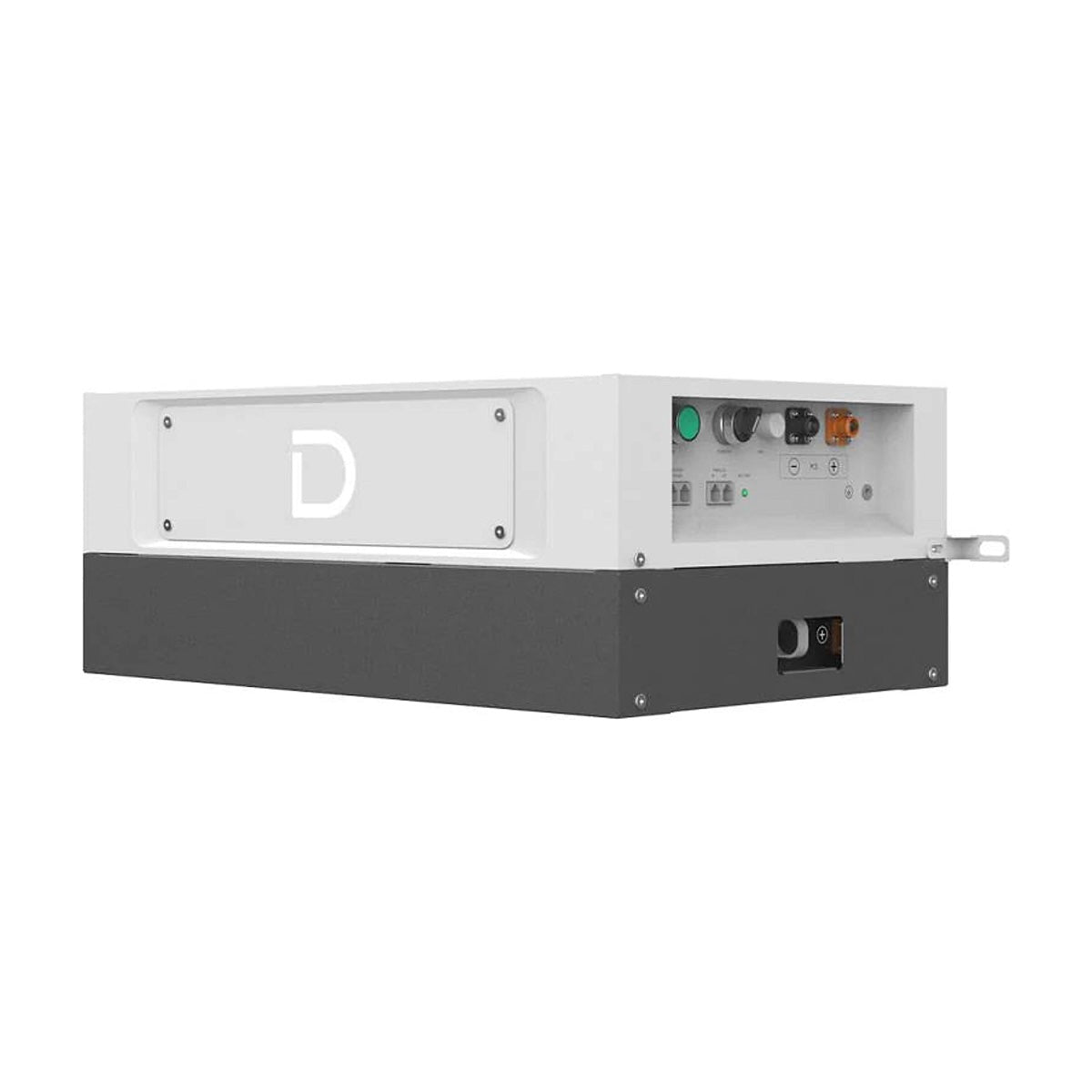
Dyness Stack 280 BDU & Base – Control Unit
Couldn't load pickup availability


The Dyness Stack 280 BDU and Base forms the central control and connection unit of a Dyness Stack 280 high-voltage (HV) energy storage system. The BDU manages the connection between the battery modules and the inverter and handles protection, communication and central control. The Base forms the mechanical foundation on which the battery modules are stacked. The system supports 3 to 15 battery modules in series per cluster, with an operating voltage of 134 V to 876 V. Up to 12 clusters can be connected in parallel. Communication with the inverter is via CAN or RS485 (RJ45 connection).
- Scalable system: Supports 3 to 15 Stack 280 battery modules in series per cluster, and up to 12 clusters in parallel.
- CAN/RS485 communication with compatible HV inverters: Officially supported combinations are available for Solis, GoodWe, Growatt, Deye and other brands, among others. Exact compatibility depends on model, firmware and configuration.
- Integrated fire protection: Built-in aerosol fire extinguisher in accordance with the product specification.
- IP20, forced air cooling: Suitable for indoor installation only.
HV battery control for 3 to 15 modules per cluster: Dyness Stack 280 BDU
The BDU measures 770 × 425 × 230 mm and the Base 770 × 425 × 133 mm; the combined weight of the BDU and Base is approx. 56 kg. With a full column of 8 modules plus the BDU, the total height is approx. 2,208 mm; the clearance to the ceiling must be at least 450 mm (floor to ceiling ≥ 2,658 mm). With more than 8 modules, two columns must be used.
The earthing resistance must be ≤100 mΩ. Use the supplied CAN terminating resistor (120 Ω) on the correct ports in parallel systems. Communication is via CAN or RS485 through an RJ45 connection. Refer to the installation manual and compatibility documentation for the required pinout and communication settings.
Please note: This package contains only the BDU and Base (Package A). The battery modules (Dyness Stack 280 HV battery module, Package B) are sold separately. A minimum of 3 battery modules is required for a functional system.
Compatible inverters and system requirements
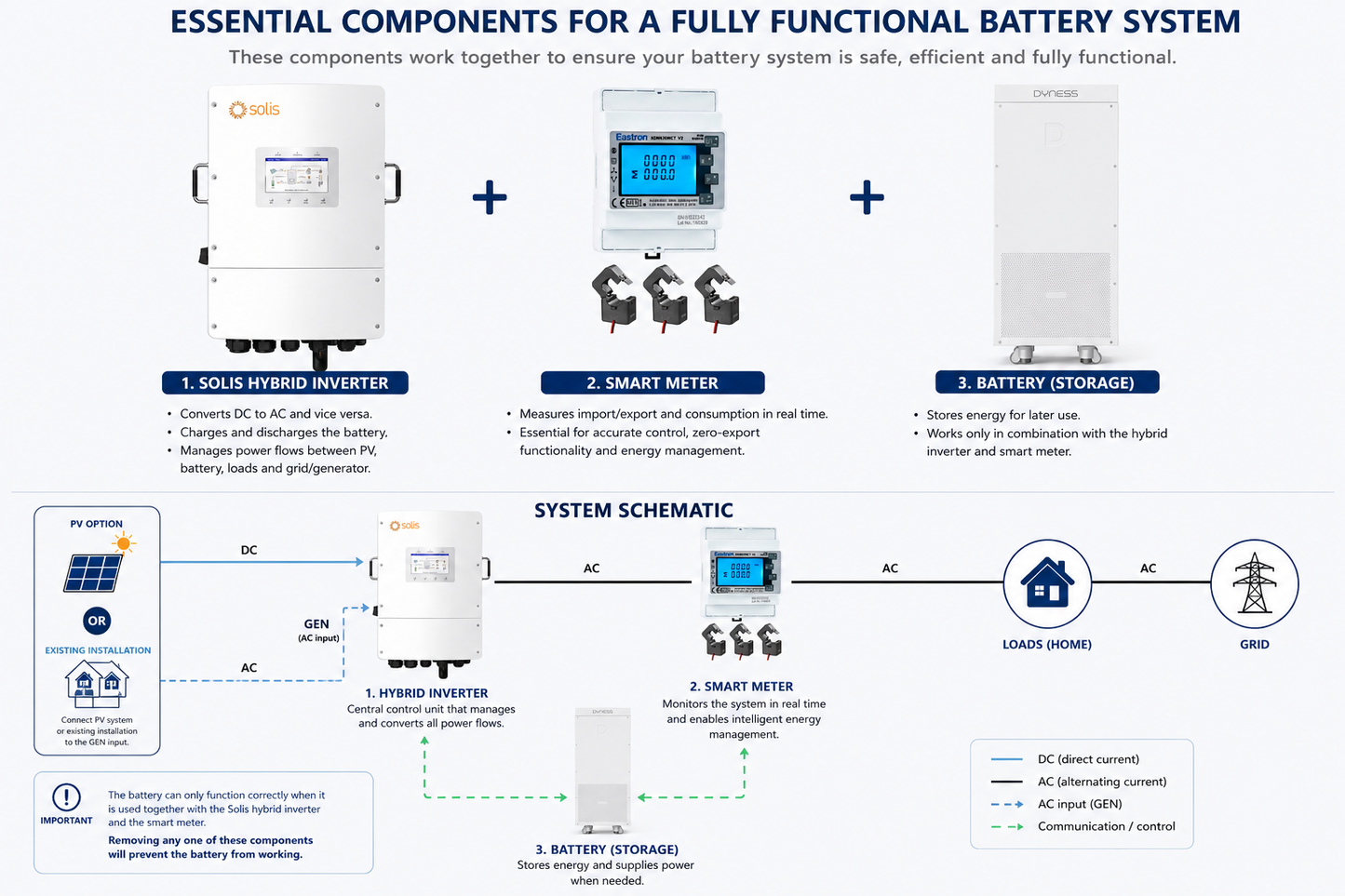
The Dyness Stack 280 BDU communicates via CAN or RS485 with compatible HV inverters. According to Dyness's official compatibility documentation, the brands listed include: Solis, GoodWe, Growatt, Deye, SINENG, SINEXCEL, Sosen, Solinteg, Atess and Magarevo. The listing of a brand does not mean that all inverters of that brand are compatible. Always consult the latest official Dyness compatibility list for the exact inverter model, firmware version, protocol selection and required settings before installation.
Full technical specifications: Dyness Stack 280 BDU and Base
| Parameter | Value |
|---|---|
| Brand and model | Dyness Stack 280 BDU and Base |
| Dimensions BDU (W × D × H) | 770 × 425 × 230 mm |
| Dimensions Base (W × D × H) | 770 × 425 × 133 mm |
| Weight BDU and Base | approx. 56 kg |
| Protection rating | IP20 (indoor only) |
| Cooling | Forced air cooling |
| Fire protection | Integrated aerosol fire extinguisher |
| Min. battery modules per system | 3 |
| Max. battery modules in series | 15 |
| Max. modules per column (recommended) | 8 |
| Max. clusters in parallel | 12 |
| Operating voltage | 134 V to 876 V |
| Min. clearance above cluster | 450 mm |
| Min. floor-to-ceiling height (8 modules and BDU) | ≥2,658 mm |
| Earthing resistance | ≤100 mΩ |
| Operating temperature | -20 °C to 50 °C |
| Optimum ambient temperature | 18 °C to 30 °C |
| Communication | CAN / RS485 (RJ45) |
| RJ45 pinout | Pin 1 = 485_B, Pin 2 = 485_A, Pin 4 = CANH, Pin 5 = CANL |
| Certifications | CE, CE-EMC, UN38.3 |
| Compatible inverters | See Compatibility section |
Dyness's official datasheet and installation manual are authoritative for technical specifications, installation and use.
Frequently asked questions about the Dyness Stack 280 BDU and Base
What is included in the Dyness Stack 280 BDU and Base package?
| Component | Quantity |
|---|---|
| BDU (770 × 425 × 230 mm) | 1 |
| Base (770 × 425 × 133 mm) | 1 |
| Mounting brackets | 2 |
| Expansion bolts M6 × 80 | 2 |
| Expansion bolts M12 × 100 | 4 |
| CAN terminating resistor RJ45-CAN-120 (120 Ω) | 1 |
| Flat-head screws M5 × 30 | 4 |
| Cable lugs OT4-6 | 2 |
| CAN communication cable (2,000 mm, RJ45) | 1 |
| RS485 communication cable (2,000 mm, RJ45) | 1 |
| Power cable positive (red, 50 mm², 2,050 mm) | 1 |
| Power cable negative (black, 50 mm², 2,050 mm) | 1 |
| User manual | 1 |
| Warranty card | 1 |
| Customer letter | 1 |
| Packing list | 1 |
Battery modules (Package B) are not included and are sold separately.
Which inverters is the Dyness Stack 280 BDU compatible with?
The Stack 280 BDU is not universally compatible with every HV inverter. Check the exact inverter model, firmware version and required CAN or RS485 settings in the official Dyness compatibility list before system selection and installation.
What are the installation requirements for the Dyness Stack 280 BDU and Base?
Installation must be carried out exclusively by qualified electrical installers in accordance with the installation manual and applicable installation regulations. The system is suitable for indoor use only (IP20). The combined weight of the BDU and Base is approx. 56 kg. With a full column of 8 modules plus the BDU (height approx. 2,208 mm), a clearance of at least 450 mm to the ceiling is required (floor to ceiling ≥ 2,658 mm). With more than 8 modules, two columns must be used. Earthing resistance ≤100 mΩ. In parallel systems, use the supplied CAN terminating resistor (120 Ω) on the correct ports. When installing on an upper floor, have the load-bearing capacity professionally assessed.
View more products in our Dyness home batteries collection.
Activate your installer account
Verify your company within 12 hours and gain immediate access to professional net pricing, engineering support and live EU inventory.